


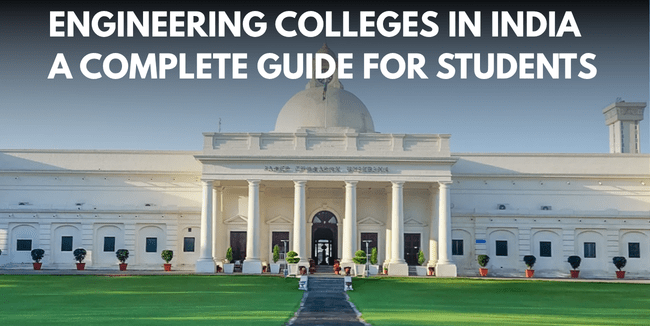
Best Engineering Colleges in India 2026: Top IITs, NITs, Fees, Exams & Admission Guide
Engineering is one of the most popular career choices in India, with lakhs of students appearing for entrance exams every year. From prestigious institutions to emerging private colleges, India offers a wide range of options for aspiring engineers.Engineers are the ones who bring new innovations that help the country in progress. In a developing country like India engineering is not only a career option, but a growth engine. Roads, bridges, smart cities, digital platforms, Bridges and startups. All these result from the hard work of the engineer.
In this blog, we will discuss in detail the importance of engineering in India, how it boosts the economy, and why this field is so popular among students. We will also discuss top engineering colleges, different branches (like Computer Science, Mechanical, Civil, etc.), and future scope. If you are considering engineering or want to understand this field, this article will give you a clear direction.
Types of Engineering Colleges in India
Engineering colleges in India, mainly divided into two categories Government (IITs, NITs, IIITs, GFTIs) and Private universities, offer B.Tech, M.Tech and diploma courses. Top government colleges are known for their low fees and strong placements, while the private and deemed universities provide modern infrastructure, However, the fees are high. Admission requires exams such as the JEE Main, JEE Advanced, and private or state-level tests.
Key Types of Engineering Colleges in India
- Indian Institutes of Technology (IITs): The most prestigious institutes that focus on engineering excellence, research, and high academic standards.
- National Institutes of Technology (NITs): Top-tier institutions funded by the central government, with 31 campuses providing high-quality engineering education.
- Indian Institutes of Information Technology (IIITs): Specialized institutes that focus primarily on the IT and communication fields, with a total of 26 centers.
- Government-Funded Technical Institutes (GFTIs): These are government colleges that provide recognized technical education outside of the IITs and NITs (e.g., PEC, BIT Mesra).
- State Government Engineering Colleges: Operated under state governments, where fees are comparatively low and seats are reserved for state students.
- Private Engineering Universities & Colleges: Private institutions known for modern infrastructure, industry exposure and international collaborations, such as BITS Pilani, VIT Vellore, LPU and Manipal Institute of Technology.
- Deemed Universities: Universities with autonomous status that design their own curriculum and courses, such as Thapar Institute of Engineering & Technology.
Top Engineering Colleges in India (Fees & Placement)
College’s Name | Fees | Salary |
IIT Madras – Indian Institute of Technology | ₹ 10.00 Lakh | ₹ 18.00 Lakh |
IIT Delhi – Indian Institute of Technology | ₹ 8.00 Lakh | ₹ 19.08 Lakh |
IIT Bombay – Indian Institute of Technology | ₹ 8.00 Lakh | N/a |
IIT Kanpur – Indian Institute of Technology | ₹ 8.00 Lakh | ₹ 19.40 Lakh |
IIT Kharagpur – Indian Institute of Technology | ₹ 8.00 Lakh | ₹ 19.76 Lakh |
IIT Roorkee – Indian Institute of Technology | ₹ 8.00 Lakh | ₹ 15.00 Lakh |
IIT Hyderabad – Indian Institute of Technology | ₹ 8.00 Lakh | N/a |
IIT Guwahati – Indian Institute of Technology | ₹ 8.00 Lakh | ₹ 34.10 Lakh |
NIT Trichy – National Institute of Technology | ₹ 5.00 Lakh | N/a |
Indian Institute of Technology, BHU, Varanasi | ₹ 8.00 Lakh | N/a |
Engineering Entrance Exams in India 2026
Top engineering entrance exams in India for 2026 includes national-level tests such as JEE Main (for NITs/IIITs) and JEE Advanced ( for IITs), along with popular private university exams such as BITSAT, VITEEE, and SRMJEEE are also important. Major state-level exams include Mahat Sat, VBJI, and COMEDK. Most exams require Physics, Chemistry, and Mathematics (PCM) as subjects.
Top National-Level Engineering Entrance Exams
- JEE Main (Joint Entrance Examination): The main entrance exam for NITs, IIITs, and CFTIs. It is conducted by the NTA in two sessions (January & April 2026).
- JEE Advanced: An exclusive exam for admission to IITs, open only to top JEE Main qualifiers.
- BITSAT: Conducted by BITS Pilani, it provides admission to the Pilani, Goa, and Hyderabad campuses, and has a slightly unique question pattern.
- CUET (Common University Entrance Test): Many central and state universities are now adopting this exam for engineering admissions.
Top Private University Entrance Exams
- VITEEE: The entrance exam of Vellore Institute of Technology, conducted for admission to different campuses of VIT.
- SRMJEEE: The Joint Engineering Entrance Exam of SRM University, which provides admission to engineering courses.
- MET (Manipal): The Manipal Entrance Test, conducted for engineering programs of Manipal University.
- COMEDK UGET: An important entrance exam for admission to private engineering colleges in Karnataka.
- LPUNEST: The National Entrance and Scholarship Test of Lovely Professional University, which offers admission as well as scholarships.
Key State-Level Entrance Exams
- MHT CET: Maharashtra Health and Technical Common Entrance Test, conducted for admission to engineering colleges in the state.
- WBJEE: West Bengal Joint Entrance Examination, through which admission is given to engineering institutions in West Bengal.
- KCET: Karnataka Common Entrance Test, considered an important exam for state-level colleges.
- AP EAMCET / TS EAMCET: Engineering, Agriculture and Medical Common Entrance Test for Andhra Pradesh and Telangana, used for admission to multiple professional courses.
Key Details & Important Dates
- Eligibility: Generally, 10+2 (or equivalent) is required with Physics, Chemistry, and Mathematics (PCM) as subjects.
- Application Timelines: Most application forms open between October and January for admissions for the next year.
- Exam Timing: Major entrance exams are usually conducted between April and May.
Preparation Tips: Strengthen PCM concepts from NCERT, practice previous year papers, and improve speed and accuracy through mock tests.
Popular Engineering Branches
Popular engineering branches in 2026 are dominated by technology and AI-based fields, with Computer Science (CSE), Artificial Intelligence & Machine Learning (AI/ML), Data Science, and Electronics & Communication Engineering (ECE) leading the way due to their high demand and salary packages. Core branches such as Mechanical, Civil, and Electrical are also relevant, especially when integrated with IoT, renewable energy, and automation.
Top Emerging & High-Demand Engineering Branches
- Computer Science & Engineering (CSE): The most sought-after field, focusing on algorithms, software development, and AI.
- Artificial Intelligence & Machine Learning (AI/ML): Works on building intelligent systems, which are expected to remain in high demand until 2026.
- Data Science & Big Data Engineering: Focuses on extracting insights from huge datasets, which drives the digital economy.
- Electronics & Communication Engineering (ECE): Deals with IoT, microchips, and telecommunications. It is considered a little tougher than CSE, but offers strong hardware-software roles.
- Cybersecurity Engineering: An important field that focuses on ethical hacking, network security, and protecting digital systems.
Engineering Admission Process in India
The engineering admission process in India primarily begins with clearing Class 12 (PCM), which generally requires a minimum of 50% marks. Students then need to qualify national-level (JEE Main/Advanced) or state/university entrance exams. The complete process includes filling out an application form, taking the exam, attending counseling (such as JoSAA), and seat allocation based on merit.
Eligibility Requirements
Candidates must have passed 10+2 (Higher Secondary) with Physics, Mathematics, and Chemistry (PCM). Typically, a minimum of 45–50% marks is required, but cutoffs for top colleges are quite high.
Entrance Examinations
Admissions are mostly through entrance exams:
- National Level: JEE Main (NITs/IIITs/GFTIs) and JEE Advanced (IITs)
- University Level: BITSAT (BITS Pilani), VITEEE (VIT), SRMJEEE, etc.
- State Level: MHT-CET, WBJEE, COMEDK UGET (Karnataka), etc.
Application Process
Students must apply online/offline for different exams and colleges, which usually take place between October and April.
Counseling and Seat Allocation
Counseling is conducted based on entrance exam scores. At the central level, JoSAA (for IITs/NITs) and state authorities conduct the seat allotment process.
Final Admission / Reporting
After receiving a seat, candidates must report to their allotted college, where document verification and fee payment are completed.
Required Documents
- Class 10th aur 12th ki marksheets
- Transfer Certificate (TC)
- Entrance exam admit card aur scorecard
- Category certificate (agar applicable ho)
- Passport-size photographs
Common Entrance Exam Timeline (2026)
- JEE Main Session 1 Registration: October – November
- JEE Main Session 2 Registration: February
- Counseling (JoSAA): Usually starts in June–July, after results.
Conclusion
Engineering colleges in India offer a wide range of opportunities for students across different interests and budgets. From top government institutes like IITs and NITs to well-established private universities, every student can find a suitable option based on their rank, preferences, and career goals. However, choosing the right college is not just about rankings, it’s about understanding your interests, checking placement records, and evaluating overall growth opportunities. Check collegedunias for more info.
FAQs
1. Which are the top engineering colleges in India?
Some of the top engineering colleges in India include IITs, NITs, IIITs, and private institutions like BITS Pilani, VIT, and SRM University.
2. What is the best entrance exam for engineering?
The most popular and important exams are JEE Main and JEE Advanced. Apart from these, there are state-level and private university entrance exams as well.
3. What is the average fee for engineering colleges in India?
Government colleges usually charge between ₹50,000 to ₹2 lakh per year, while private colleges may charge ₹2 lakh to ₹5 lakh or more annually.
4. Which engineering branch has the best career scope?
Computer Science Engineering currently offers the best career opportunities due to high demand in IT, AI, and software industries. However, other branches like Mechanical, Civil, and Electrical also have good scope depending on your interest.
5. Are private engineering colleges worth it?
Yes, many private colleges offer good infrastructure, placements, and exposure. However, it is important to research properly before taking admission.
6. How important are placements while choosing a college?
Placements are important, but they should not be the only factor. You should also consider faculty, infrastructure, location, and learning opportunities.
7. Can I get admission without JEE?
Yes, many private universities and some state colleges offer admission through their own entrance exams or merit-based criteria.