


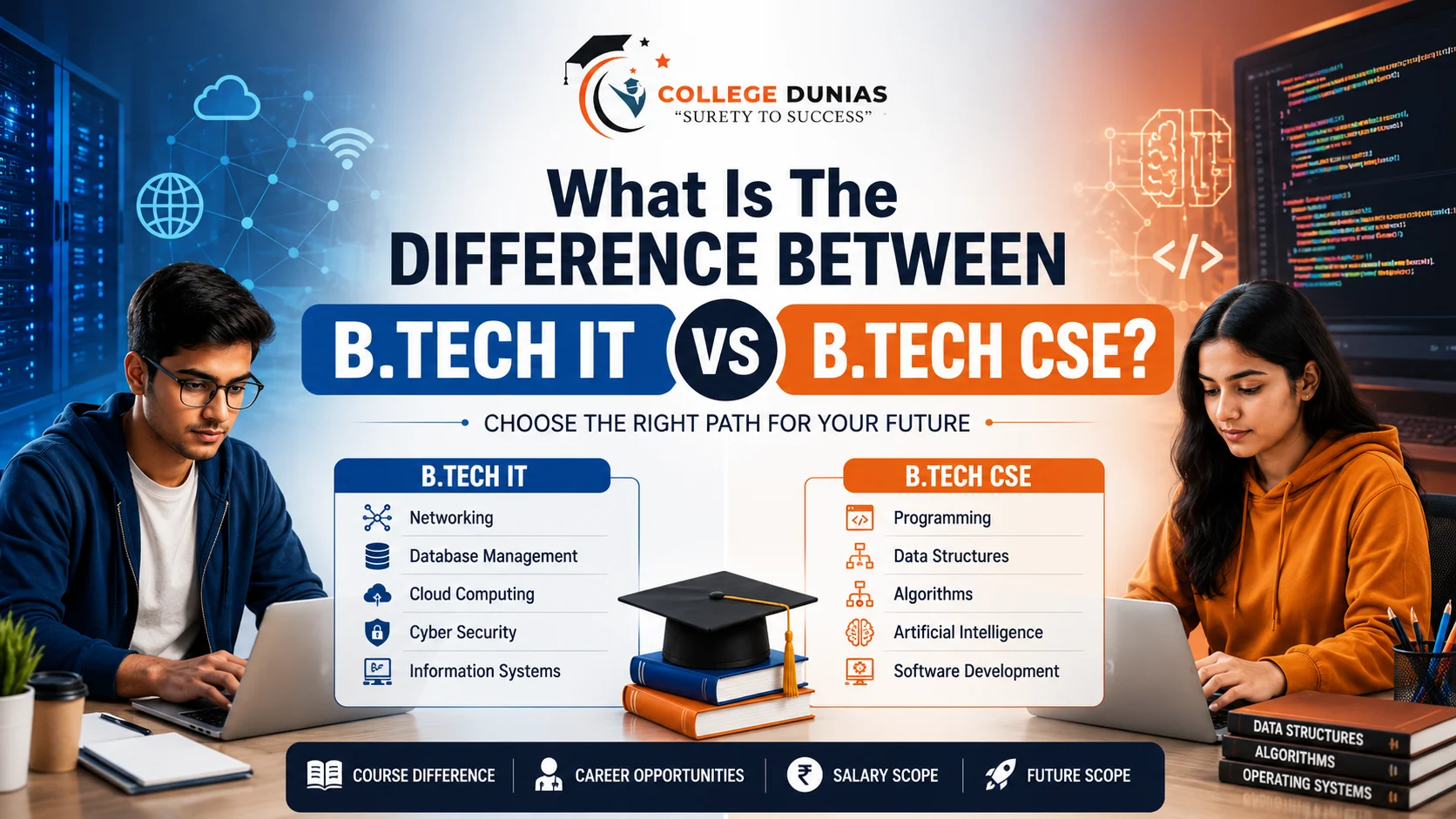
What Is The Difference Between B.Tech IT vs B.Tech CSE?
In today’s time the most common confusion for engineering aspirants is what is the actual difference between B.Tech IT vs B.Tech CSE. Both branches are related to the computer and technology field, both have good career scope, and both are very popular in private and government colleges. But when it comes to admission, both parents and teachers get confused about which branch is better, which branch’s syllabus is more useful, and which option will be strong for placement.
If you are also confused, then this guide is for you. In this blog we will understand the difference between B.Tech IT vs B.Tech CSE, syllabus, subjects, career scope, salary, placements and which branch will be best for which student. If you’re planning B.Tech Admission in Uttar Pradesh or B.Tech Admission in Delhi, this comparison will make your admission decision much easier. Many students also seek the help of a B.Tech Consultant in Uttar Pradesh or an IP University Admission Consultant in India for expert guidance at this stage, so that branch and college selection can be done correctly.
B.Tech IT vs B.Tech CSE: Basic Understanding
First it is important to understand the basic difference. The full form of B.Tech CSE is Bachelor of Technology in Computer Science and Engineering, while the B.Tech IT refers to Bachelor of Technology in Information Technology.
In simple words then Computer Science Engineering (CSE) is a more broad branch which focuses on computer’s core concepts like programming, algorithms, data structures, operating systems, artificial intelligence, machine learning, database management, software engineering, and computer architecture. On the other hand, Information Technology (IT) focuses more on information systems, software applications, networking, database handling, cyber security and business technology solutions.
That is why when students choose B.Tech IT or B.Tech CSE, they should understand that both are related, but the focus area is slightly different.
B.Tech IT vs B.Tech CSE: What is the Main Difference ?
If we directly compare B.Tech IT and B.Tech KSSE, the biggest difference is in their academic focus and practical orientation.
B.Tech CSE focuses:
- Programming and coding fundamentals
- Data structures and algorithms
- Software development
- Computer architecture
- Artificial Intelligence and Machine Learning
- Operating systems
- Cloud computing, DevOps, advanced computing concepts
B.Tech IT focuses:
- Information systems
- Networking
- Database administration
- Web technologies
- Cyber security basics
- Software implementation and management
- Business-oriented IT solutions
This doesn’t mean that IT doesn’t include coding or CSE doesn’t include networking. There is overlap between the two, but the depth and priorities differ. Therefore, when choosing a B.Tech IT versus a B.Tech CSE, you should consider your interests.
B.Tech IT vs B.Tech CSE: Syllabus Difference
There’s also a noticeable difference in syllabus between B.Tech IT and B.Tech CSE. The syllabus for both branches can be nearly identical in the first year, as engineering fundamentals are common. However, specialization subjects begin to emerge from the second year.
B.Tech CSE subjects may include:
- Programming in C/C++/Java/Python
- Data Structures
- Design and Analysis of Algorithms
- Operating Systems
- Computer Networks
- DBMS
- Software Engineering
- Theory of Computation
- Compiler Design
- Artificial Intelligence
- Machine Learning
- Cloud Computing
B.Tech IT subjects may include:
- Web Technology
- Database Management Systems
- Computer Networks
- Information Security
- Java Programming
- Data Analytics basics
- Cyber Security fundamentals
- E-Commerce Technology
- Software Project Management
- Mobile Application Development
- Network Administration
Here you can clearly see that in B.Tech IT vs B.Tech CSE, CSE is a bit more theoretical + core computer science oriented, whereas the structure of IT is more tilted towards practical application and information systems side.
Which Branch has more Coding?
This is the most common question when students compare B.Tech IT vs B.Tech CSE. Generally, CSE offers slightly more exposure to coding, algorithms, and core programming. If you’re targeting problem-solving, logic building, software development, AI, machine learning, coding competitions, or product-based companies, CSE may be a stronger option for you.
However, if you’re interested in software systems, IT infrastructure, networking, databases, application management, and business technology solutions, IT is an equally valuable branch. Nowadays, IT students can easily move into coding roles, testing roles, data roles, and support engineering profiles.
B.Tech IT vs B.Tech CSE: Career Scope
From the point of view of career opportunities, B.Tech IT vs B.Tech CSE are both strong branches. Digital transformation in India, software industry, startups, AI tools, cloud infrastructure and cybersecurity demand are providing good opportunities to students of both streams.
B.Tech CSE ke common career options:
- Software Developer
- Full Stack Developer
- Data Analyst / Data Engineer
- AI/ML Engineer
- Cloud Engineer
- DevOps Engineer
- Cyber Security Analyst
- App Developer
- System Programmer
B.Tech IT ke common career options:
- IT Analyst
- Network Engineer
- System Administrator
- Database Administrator
- Software Tester
- Web Developer
- Cyber Security Associate
- Technical Support Engineer
- Cloud Support Executive
- IT Consultant
The important thing here is that the job role doesn’t depend solely on the branch. Your coding skills, projects, internships, certifications, and communication skills are equally important. Therefore, the decision between B.Tech IT and B.Tech CSE should be made not just based on the name, but also on long-term career interest.
Salary Comparison: B.Tech IT vs B.Tech CSE
Students also compare B.Tech IT vs. B.Tech CSE quite a bit in terms of salary. Generally, CSE students in top colleges can get slightly better packages because product-based companies target CSE graduates. But this is not a hard rule.
If you are doing IT from an average college and have strong coding skills, projects, certifications and internship experience, then you can crack the same or sometimes even better package than CSE students.
Fresher level average roles:
- IT / Support / Testing roles: 3 LPA – 6 LPA
- Software / Development roles: 4 LPA – 10 LPA
- Product-based companies: 8 LPA+ possible
- High-skill AI, data, cloud roles: skill-based packages vary widely
So, not just the branch, but also the college and skill set play a role in salary comparisons. Therefore, when choosing B.Tech IT vs. B.Tech CSE, you should also consider the type of career you want to build.
Which Branch is Better: IT or CSE?
This question has a one-word answer, because “better” completely depends on the student’s interest.
Choose B.Tech CSE if:
- You like coding.
- You want to pursue a career in software development.
- You find algorithms, logic building, and problem-solving interesting.
- You want to target AI, ML, Data Science, or software product roles.
Choose B.Tech IT if:
- You like to understand the practical/business applications of technology.
- You are interested in networking, systems, databases, and cybersecurity.
- You want to explore IT infrastructure or support-to-development hybrid roles.
- You find software systems and implementation interesting.
Therefore, the right answer for B.Tech IT and B.Tech KSSE can be different for every student.
Admission Planning: Along with branch selection, college selection is also important
Just choosing a branch is not enough; college selection is equally important. Sometimes a strong IT college can be a better option than an average CSE college, depending on faculty, placements, internships, exposure and fee structure.
If you are looking for B.Tech Admission in Uttar Pradesh, you should compare AKTU affiliated colleges, private universities and placement records. Similarly, for B.Tech Admission in Delhi, analysis of IP University affiliated colleges, private universities and NCR colleges is necessary.
Many students nowadays seek the help of a B.Tech Consultant in Uttar Pradesh because they need combined guidance on branch, college, fees, placement, and eligibility. If you’re planning a Delhi NCR location, the guidance of an IP University Admission Consultant in India can also be useful, especially when understanding the counseling process, seat options, branch preference, and backup colleges.
B.Tech Admission in Uttar Pradesh: IT and CSE Both are good Options
Uttar Pradesh offers a wide range of colleges for engineering aspirants, offering both B.Tech IT and B.Tech CSE branches. If you’re exploring B.Tech admission options in Uttar Pradesh, you should check out:
- College placement record
- CSE and IT branch’s separate average package
- Labs, coding culture and internship support
- Faculty and industry exposure
- Location advantage and fee structure
Many students seek the help of a B.Tech consultant in Uttar Pradesh to create a shortlist based on their rank, budget, and branch preference. This is especially useful if you’re unsure whether to pursue IT or CSE.
B.Tech Admission in Delhi: IPU aur NCR Options
If you are looking for B.Tech Admission in Delhi or Delhi NCR colleges, then multiple options are available here for both CSE and IT. The advantage of the Delhi region is that one can get better internships, startup exposure and tech ecosystem here. Hence many students take counselling support from IP University Admission Consultant In India to get the best branch-wise options.
Whether you are looking for B.Tech Admission in Delhi or B.Tech Admission in Uttar Pradesh, in the final decision you should give priority to the branch along with placement support, faculty quality and skill-building environment.
Final Verdict on B.Tech IT vs B.Tech CSE
In short, the difference between B.Tech IT vs B.Tech CSE is mainly in the focus area. CSE focuses more on concepts like core computer science, coding, software development and AI, whereas IT is centered on networking, databases, information systems and technology implementation. Both branches have good scope, but the right choice depends on your interest, career goals and skill set.
If you are in the admission planning phase and exploring the options of B.Tech Admission in Uttar Pradesh or B.Tech Admission in Delhi, then college selection is equally important along with branch selection. To make this process easier, you can take expert guidance from CollegeDunias. Whether you need B.Tech Consultant in Uttar Pradesh support or IP University Admission Consultant In India level guidance, CollegeDunias can help you reach the best branch and college choice.
FAQs on B.Tech IT vs B.Tech CSE
1. Which branch is better in B.Tech IT and B.Tech KS?
If you’re interested in coding, software development, and AI, CSE might be a better fit. If you’re interested in networking, databases, and IT systems, IT is a good option.
2. Can B.Tech IT students become software developers?
Yes, B.Tech IT students can pursue careers in roles like Software Developer, Web Developer, Tester and IT Analyst.
3. Is the scope of B.Tech more than IT?
The scope of CS is considered a little broader, but both IT and CS offer good placements and career opportunities.
4. Which branch should I choose for B.Tech admission in Uttar Pradesh or Delhi?
The branch depends on your interest. It is important to consider college placements, curriculum, and future career prospects at the time of admission.
5. Where can I get guidance for college selection?
If you are confused in branch and college selection, then you can take expert guidance from CollegeDunias for B.Tech Admission in Uttar Pradesh, B.Tech Admission in Delhi, and IPU-related counselling support.